
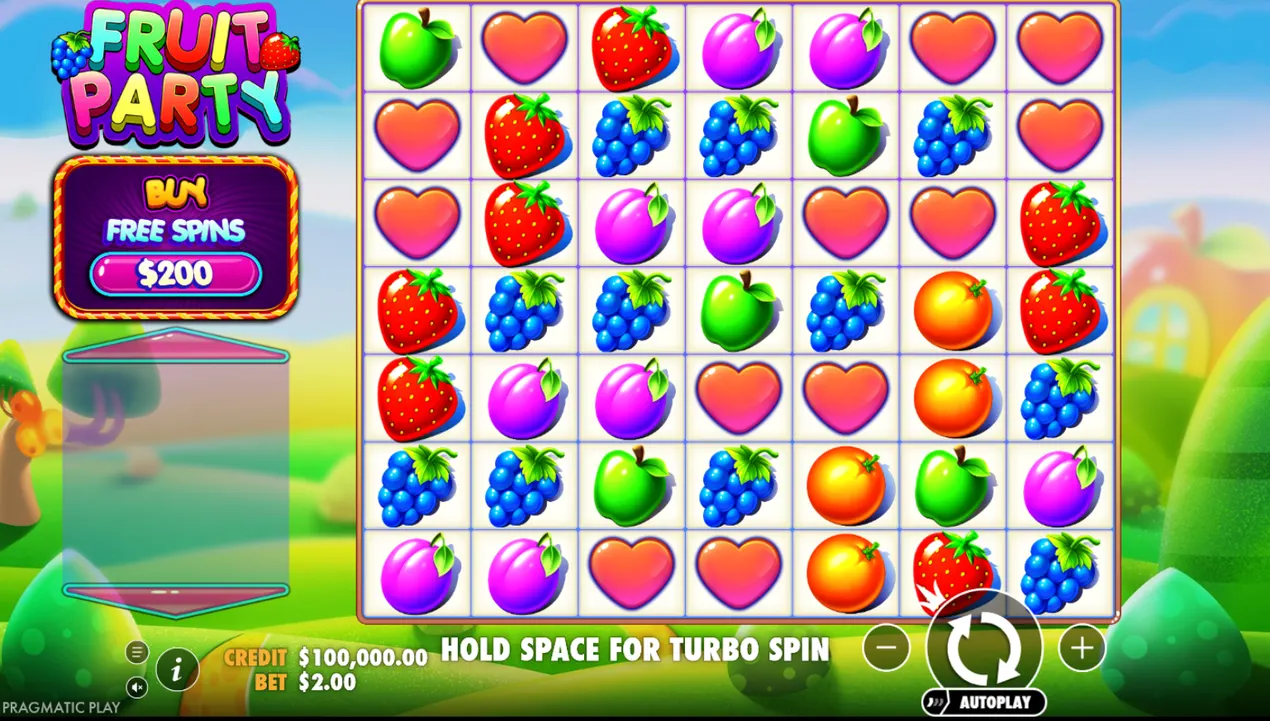
What we look at first
Before writing anything about a slot, we separate what a studio publishes on its own domain from what independent testing and cross-referenced databases report. For Fruit Party, Pragmatic Play's official game page confirms the format — a 7×7 cluster grid with no fixed paylines — but does not state RTP, volatility, or the maximum win multiplier. That gap is common; plenty of Pragmatic titles ship without a public math sheet on the studio site, and we don't fill it in with an industry-typical figure just to complete a table.
Instead we pull the certified numbers from technical spec sources and casino portals that mirror the game's help screen. For Fruit Party this produced a consistent picture: a default RTP of 96.47%, with two additional certified configurations at 95.48% and 94.45%. Multiple RTP settings on the same title are normal for Pragmatic — operators can select which build they run — so we report the range rather than pretending one number applies everywhere.
Volatility gets the same treatment. Most detailed sources classify Fruit Party as high volatility, which lines up with the mechanical evidence: a hard 5,000× stake cap, stacked random multipliers reaching an effective ×256 within a single cluster, and a hit frequency near 25-26%. A handful of listings call it medium instead. We flag that disagreement once, in the specs section, and don't repeat it through the rest of the page.
We also check for structural errors that get copied between sites. Some pages describing 'Fruit Party' actually list 20 paylines on a 7×7 layout — a spec that belongs to a different game entirely, since the real Fruit Party pays exclusively through connected clusters of five or more matching symbols. Catching that kind of mismatch is part of the review process, not a footnote we skip.
Where sources disagree
Three points needed a judgment call on this title: the exact release day (databases split between 21 May and 28 May 2020, though the year is consistent), the volatility label (high versus medium), and a stray 96.50% RTP figure that ignores the game's multi-configuration setup. We treat the majority-supported values as the working baseline and note the split once rather than qualifying every subsequent paragraph.
How mechanics get verified before we describe them
Feature descriptions go through the same scrutiny as the numbers. Fruit Party's tumble mechanic, its scatter-triggered free spins, and its lack of a wild symbol are confirmed across enough independent technical breakdowns that we treat them as settled. The bonus buy question is simpler: the original Fruit Party ships without one, and no source we checked contradicts that, so we state it plainly rather than hedging.
The multiplier system needed closer reading. Random ×2 and ×4 multipliers attach to individual symbols during the base game and more frequently during free spins; when several multiplier-carrying symbols land inside the same winning cluster, their values compound rather than add. That's how a single cluster can reach the ×256 ceiling cited in spec-style sources — a mechanical detail worth explaining, since it's the main driver of the game's higher-end volatility, not just a number on a paytable.
We also confirm availability claims before publishing them. Fruit Party's demo is hosted directly by Pragmatic Play and mirrored by numerous casino sites, and the HTML5 build runs on both desktop and mobile browsers without a separate app. For Canadian players specifically, we note that access runs through provincially regulated platforms where applicable or through offshore-licensed operators, and that bet limits or the active RTP configuration can vary by operator — details worth checking in a casino's own game information panel before playing.
This page exists so that when a spec, a feature description, or a volatility label appears elsewhere on the site, readers know it passed through this same check rather than being copied from a single unverified listing.